FAQ's
In almost 60 years in operation, we’ve fielded a lot of customer questions. Here are the answers to some of our most common questions.
Frequently Asked Questions
A Code truck is specifically designed, certified, verified, tested, inspected, and documented at every stage of its build process to demanding ASME, NBBI, and US DOT & FMVSS hazardous materials transport standards. If this sounds like a lot, well, it is. Code trucks are designed to provide robust protection against leaks or spills of their hazardous contents over the full life of the unit. Non-code trucks, put simply, don’t offer any of these protections, and shouldn’t be used to haul hazardous materials.
All Code tanks must undergo the same documentation, inspection, and testing. Where a tank goes from acceptable to exceptional is in how far it goes above the bare minimum requirements. Cusco’s tanks are built thicker, from higher-grade steel, and feature additional external reinforcement. Our goal – allow the user to keep passing leak, pressure, and thickness tests year after year, extending the unit’s useful Code life, and providing additional unit income over time.
Regular maintenance is key to extending any machine’s unit life while reducing long-term unit cost of ownership. The two primary ways to make this happen – 1) make maintenance points easy-access, and 2) make components easy to replace. Cusco’s are as easy to service as possible, encouraging completion of scheduled maintenance. All major preventative maintenance points are accessible from ground level. If the operator has to climb up on the unit to perform daily maintenance, chances are higher that something (or someone) will be allowed to slip. Cusco also bolts on high-wear components, such as the side hose trays, versus welding them onto the unit frame. This approach allows change-out without specialized skills or equipment and dramatically reduces unit downtime. Even the entire body is bolted, not welded, onto the frame rails, allowing the tank to potentially outlive the chassis itself.
Look for manufacturers who can prove that their bumpers and overturn systems are built and tested to DOT standards. While Code tanks are subject to rigorous certification, external protective systems are manufacturer certified. If a Code truck supplier can’t prove that they’ve Finite Element Analysis (FEA) tested their overturn systems to resist deformation in a full-weight rollover scenario, and their bumpers from a severe rear impact, your tank won’t be adequately protected while on the road. Remember, even if the tank is intact, damage to or loss of valves, manway hatches, or fill indicators can result in a loss of material containment. These components are what Cusco’s fully DOT-compliant (and fully documented) protective systems are designed to protect.
Cusco collaborates with all major chassis suppliers. Contact us for more details.
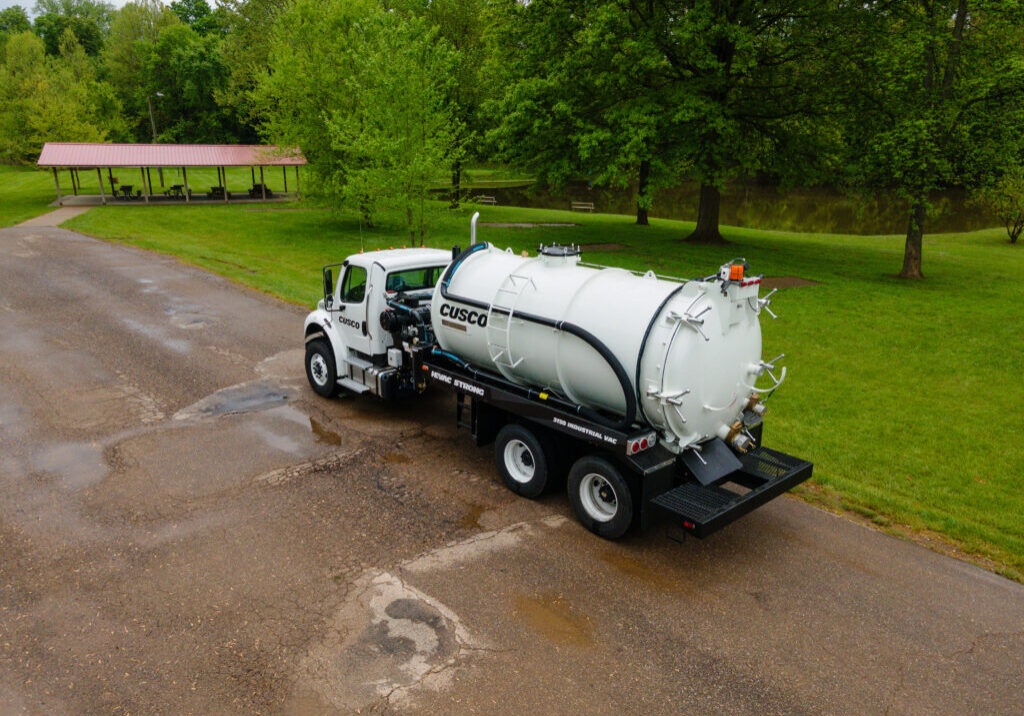
Cusco builds non-code trucks with Code levels of durability and ease of use. If you’re looking for a waste truck for the “long haul”, but aren’t planning on hauling hazardous waste, Cusco’s non-Code waste trucks will give you superior usability and unit life when compared to a generic septic truck.